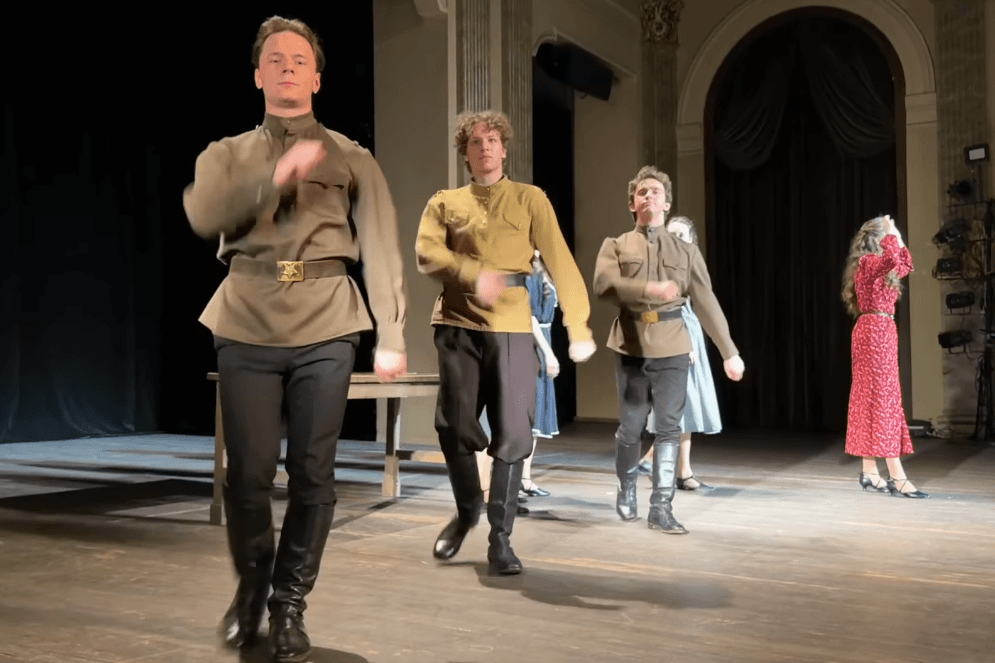
Russian students put on a play about the Red Army in WWII, replete with Soviet-era war songs, at Tbilisi Shota Rustaveli State Theatre’s small stage. Amid criticism, the theatre’s director told the media that the venue had been rented out to the group.
Information about the 14 May performance was released two days later by the Russian Interests Section at the Swiss Embassy in Georgia. The section stated that the production featured final-year students of the Russian Institute of Theatre Arts (GITIS), a state-funded institution based in Moscow.
‘A concert dedicated to the 81st anniversary of the Great Victory’, the Facebook post read.
Among the ‘legendary melodies’ performed during the show, the section named Soviet-era and WWII-associated songs such as Katyusha, Dark Is the Night, and The Blue Scarf.
‘In addition to the musical performances, the actors delivered moving recitations of the immortal works of poets and writers of that era, including Konstantin Simonov, Aleksandr Tvardovsky, as well as Robert Rozhdestvensky and Vladimir Vysotsky’, the post read.
According to the section, guests included representatives of the diplomatic corps, business and academic circles, public and cultural organisations, as well as Russian compatriots, who ‘greeted each performance with applause’.
‘Sacred poetic memories of the heroic chapters of our shared history, of the Great Patriotic War, will forever remain in the hearts of the peoples of Russia and Georgia’, it concluded.
The Soviet Union’s WWII victory over Nazi Germany, referred to as the Great Patriotic War, had become a curated and sacralised version of the history of the war in both Soviet times and in modern-day Russia that omits the controversial chapters of the era, such as the Molotov–Ribbentropp Pact, the invasion and annexation of the Baltic states, or the mass repression and deportation of various nationalities within the USSR, including in the Caucasus.
The historical memory of the Great Patriotic War has taken on a newfound importance for the purposes of propaganda amidst Russia’s full-scale invasion of Ukraine in 2022, alongside the Kremlin’s efforts to build an ideological foundation for the military aggression.
‘I can’t believe this happened in Georgia, at the Rustaveli Theatre’, wrote the director of the Tbilisi-based Social Justice Center (SJC) Tamta Mikeladze, on Facebook.
Mikeladze noted that, in modern-day Russia under President Vladimir Putin, the discourse surrounding WWII no longer functions as a historical experience.
‘Instead, it has been transformed into a state cult, where victory is presented as proof of Russia’s exceptional civilisational mission, while critical reflection is treated almost as betrayal’.
‘Phrases such as “the heroic chapters of our shared history” are not neutral cultural language. They form part of an imperial politics of memory, in which Russia is once again presented as the historical centre, while post-Soviet societies are portrayed as belonging to a single “civilisational space” ’, she added.
Mikeladze further emphasised that the memory of WWII is not inherently problematic and that it was ‘a painful experience for our people’ that requires study.
‘But what is problematic is its Kremlin-style, colonial–political instrumentalisation’, she added.
Alongside the performance itself, reactions on social media also focused on an interview with one of the participating students, in which he expressed satisfaction with the reception in Tbilisi and added that it felt ‘as if it’s not another country, another city — as if it’s not another country, or another city — as if we always were here and always will be’.
In a phone interview with the opposition-leaning TV Pirveli, the director of the theatre, Gia Tevzadze, said that the stage had been rented out to the group and that the theatre had received ‘the maximum amount of money’ for it.
‘We suffered the most in this war’, Tevzadze responded when asked whether holding such a performance at a Georgian theatre was inappropriate.
Asked another question — whether they would rent out the stage again if a similar offer were made — Tevzadze replied:
‘Of course, we would rent it out for the money’.
Regarding the performance, the Culture Ministry told local media that ‘the theatre is a legal entity under public law and independently conducts its activities in accordance with the procedures established by Georgian legislation’.Based on archival conscription records, it is estimated that up to 700,000 people were drafted from Georgia — then part of the Soviet Union — during the Second World War.
Although the exact number of fatalities is difficult to determine, the human toll was dramatic and certainly in the hundreds of thousands, with historian Dimitri Silakadze noting in 2019 that ‘there is no family in Georgia whose ancestors did not perish in this war’.