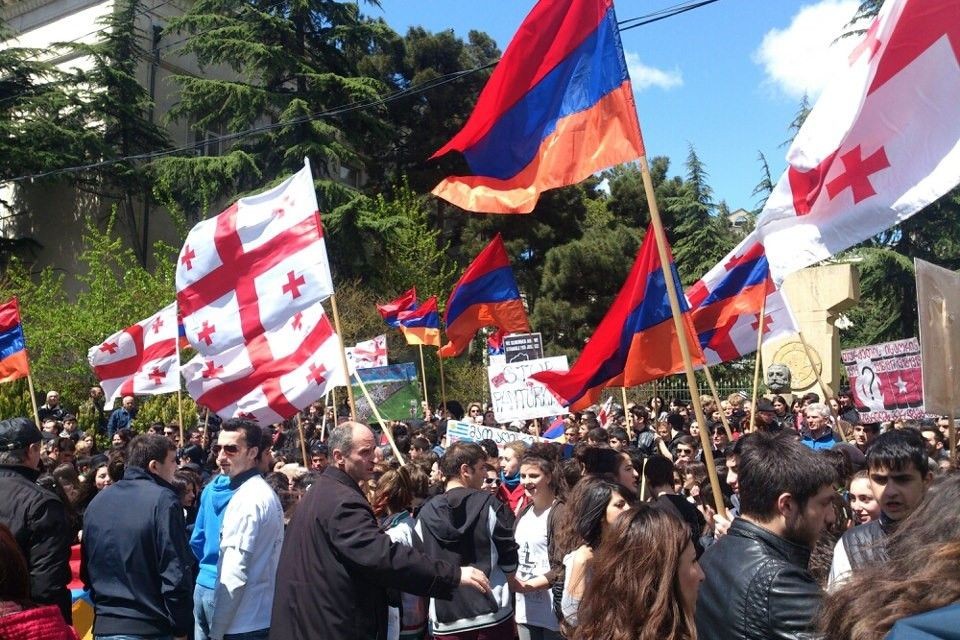
Georgia’s Interior Ministry has denied a request by an Armenian civil society group to hold a demonstration in front of the Turkish Embassy in Tbilisi on the occasion of the Armenian Genocide Remembrance Day.
The Armenian Community of Georgia, the organisation behind the demonstration, told OC Media that they initially notified Tbilisi City Hall at the end of March about the rally planned for Friday.
A board member and secretary of the organisation, Zhaneta Baghdasarian said that the police contacted them a few days later and informed them that they would not be allowed to hold their demonstration in front of the embassy.
‘[The Ministry representative] informed us that we are denied [the opportunity] to hold the event at the specified location, citing the motive to prevent potential risks’, a statement from the organisation read.
According to the organisation, they requested a written document confirming the refusal decision, after which they encountered a ‘lack of coordination between government agencies’.
‘The City Hall and the Interior Ministry were not aware of any such decision’, the statement said, going on to describe the subsequent communication with both agencies and the difficulties in obtaining an official document.
The organisation further noted that the problematic communication continued until 21 April, when they were finally able to obtain an official letter from the ministry.
The letter, cited in the statement, referred to the Georgian law on assemblies and demonstrations, stating that the ministry is obliged to maintain a balance between the freedom of assembly and the rights of individuals who live, work, or conduct business in the areas where a demonstration is held. The ministry emphasised that these individuals should not be hindered in doing their activities.
‘Given the specified location and its particular characteristics, holding the assembly may lead to a risk of violating the requirements established by the above-mentioned norm; therefore, we ask you to consider the advisability of changing the location of the event’, the ministry’s statement concluded.
 Arshaluys Barseghyan
Baghdasarian described the letter and its justification as ‘unclear’, noting that similar rallies had been held near the embassy over the past 20 years.
‘The Georgian government knows that our demonstration is peaceful. There have been no provocations, no incidents over these 20 years that would justify restricting our demonstration or our ability to freely express our opinions’, she added.
Baghdasarian said that the community organisation is not considering holding the rally at another location and, therefore, will not hold the demonstration at all.
‘It was a matter of principle for us to hold the demonstration there, as our demand is for Turkey to recognise the Armenian Genocide’, she added.
OC Media has contacted the Interior Ministry for comment on the matterr, but had not received a response at the time of publication.
Unlike the 24 April rally, the community held its annual torchlit procession the day before, from the Isani Metro Station to the St. Etchmiatsin Church in Avlabari. In this case, the Interior Ministry greenlit the planned route, but emphasised that participants had to remain on the pavement.
Under the protest-related restrictions passed by the ruling Georgian Dream party and its allies in December 2025, an obligation was introduced to notify the police before holding a protest in ‘people’s movement’ zones — including on the pavement — and wait for their response.
The police have the authority to change both the location and timing of a protest. Failure to comply with the law could result in imprisonment on the first offence. Numerous participants of daily anti-government rallies in Tbilisi have received days-long sentences after the legislation was passed.
Before the amendments were adopted, it was mandatory to notify municipal authorities — not the police — only in cases where a protest was expected to block a road; however, there was no obligation to wait for a state response — something that now exists not only for roadways but also for pavements and is overseen by the police.
Although the Armenian community had largely been able to hold rallies near the Turkish Embassy without restrictions in previous years, there have been exceptions.
In 2017, Tbilisi City Hall told organisers that holding the gathering at that specific location was not advisable, citing potential traffic disruptions.
Earlier, in the case of the 2016 rally, which coincided with tensions in the Nagorno-Karabakh conflict, the organisers said they changed the location of the demonstration at the government’s request and in order to avoid potential provocations.
This article was translated into Russian and republished by our partner SOVA.