★★★★☆
Long before Mikheil Kalatozov became a master of Soviet cinema, he made a Georgian film the regime could not forgive.
When someone mentions Mikheil Kalatozishvili — better known to the world by his Russified name, Mikhail Kalatozov — cinephiles are likely to think of I Am Cuba and The Cranes are Flying and their visually striking camerawork. But before those world-renowned masterpieces, Kalatozov began his film career as a studio projectionist and driver, gradually working his way up to camera operator and then director-cinematographer — the role he claimed for himself on one of the most interesting Georgian documentaries ever made: Salt for Svanetia (Jim Shvante).
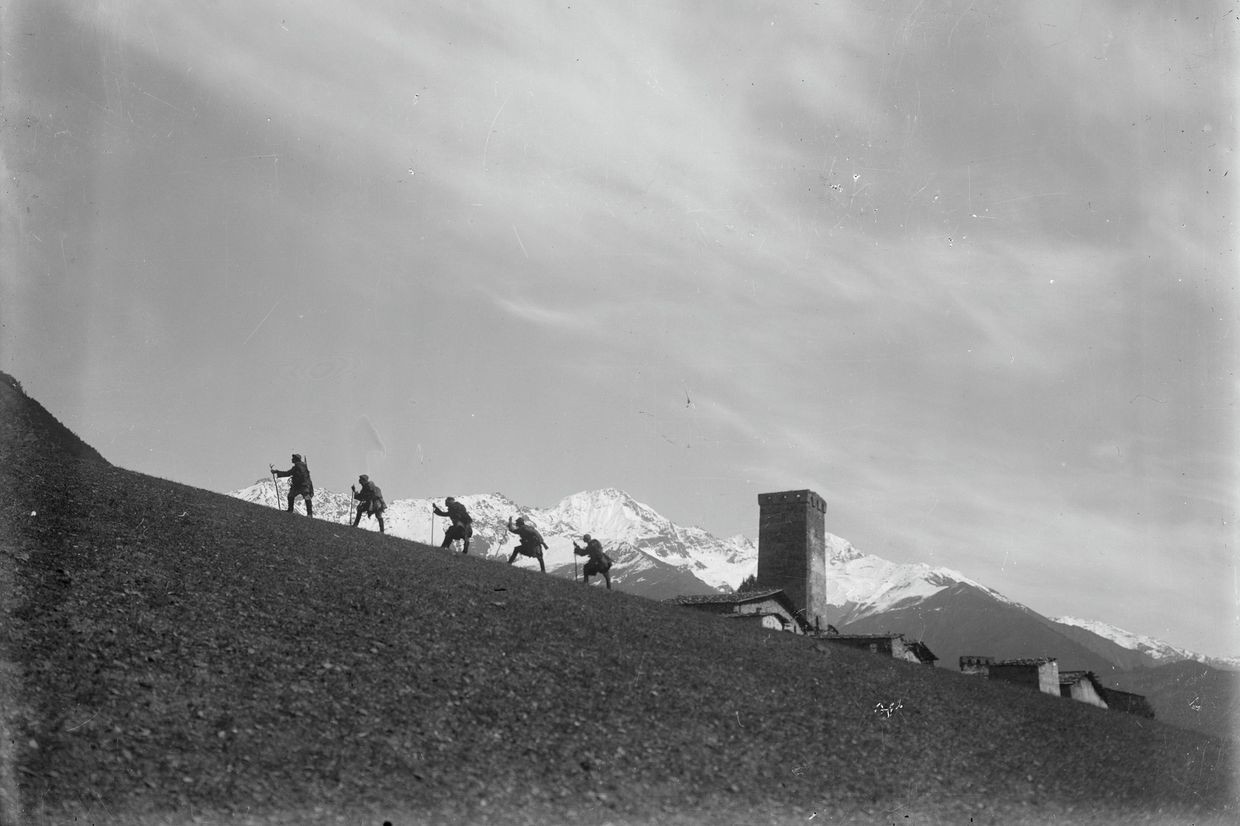
Salt for Svanetia (1930) is memorable for its genre-defying quality, blending fiction, documentary, propaganda, and travelogue into something that resists easy categorisation. It is equally memorable for its camerawork, shared between Kalatozov and Shalva Gegelashvili: extreme close-ups, aggressively tilted and rotating angles, a shot geometry that leans toward the diagonal and leaves the viewer slightly dizzy, dramatic shadows sculpted against the blinding white of the Caucasus Mountains, and a montage rhythm that transforms mundane labour into something mythic. The influence of celebrated Georgian modernist painter David Kakabadze, who served as art director, is visible throughout — his constructivist sensibility shapes how towers, rock faces, and human figures are framed as formal geometric elements rather than purely documentary subjects.
The mute film follows the Svan community of Ushguli through the full rhythm of their isolated existence. We see wool spun with spindles that predate the spinning wheel, cattle dragging stone platforms across a field, suspension bridges swaying over rushing water, the making of hats, the cutting of hair. A wealthy man’s funeral unfolds with slaughtered cattle and horses ridden to exhaustion — customs the Svan community has since disputed as either staged or misrepresented. A woman on the verge of giving birth is driven from her home into the cold, deemed unclean by ancient custom. Men haul sacks of salt over a snowbound mountain pass, only to be buried by an avalanche. Salt is the film’s central preoccupation: without roads connecting Ushguli to the outside world, it is a luxury the village can barely access, and its absence shapes everything.
The film was commissioned as a vehicle for First Five-Year Plan, and its ideological framing is announced from the very first frame: a quote by Lenin declaring that ‘even now there are far reaches of the Soviet Union where the patriarchal way of life persists along with remnants of the clan system’. Yet the film's longest section does not portray the Svan people as backward victims awaiting salvation. They are filmed with a visual language that borders on reverence. Even the final passage with its idealised bodies of shirtless, muscular construction workers and the road arriving and bringing the promise of salt and civilisation feels less like liberation than like the closing of something irreplaceable.
The film’s hostile reception in the Soviet Union was not surprising. Official critics accused Kalatozov of formalism, claiming he had romanticised Svaneti’s backwardness rather than condemning it, offered only superficial engagement with the Five-Year Plan's modernising project, and failed to foreground the leading role of the Communist Party. Kalatozov responded with a self-critical article in Proletarskoe Kino, conceding he had over-emphasised geography at the expense of class analysis. His next film was also banned, and he did not direct again for years.
From today’s perspective, Salt for Svaneti is one of the most important documentaries of the Soviet era — and its significance has only deepened over time. The poetic Georgian cinema of the 1960s and 70s, represented by directors like Tengiz Abuladze and Otar Iosseliani, is inconceivable without it. Kalatozov's use of Georgian landscape, mythology, and folk tradition as raw material for formally radical cinema established a template that Georgian filmmakers would return to repeatedly, and the film remains a touchstone of Georgian cultural identity to this day.
Film details: Salt for Svanetia (1930) directed by Mikhail Kalatozov is available to watch on Klassiki with a new score by Liza Kalandadze and Georgian intertitles, and on YouTube with the original Zoran Borisavljevic score and English subtitles.