★★★☆☆
Zaza Burchuladze’s war novel is not an easy book to love — but in 2026, it is an uncomfortably easy book to recognise.
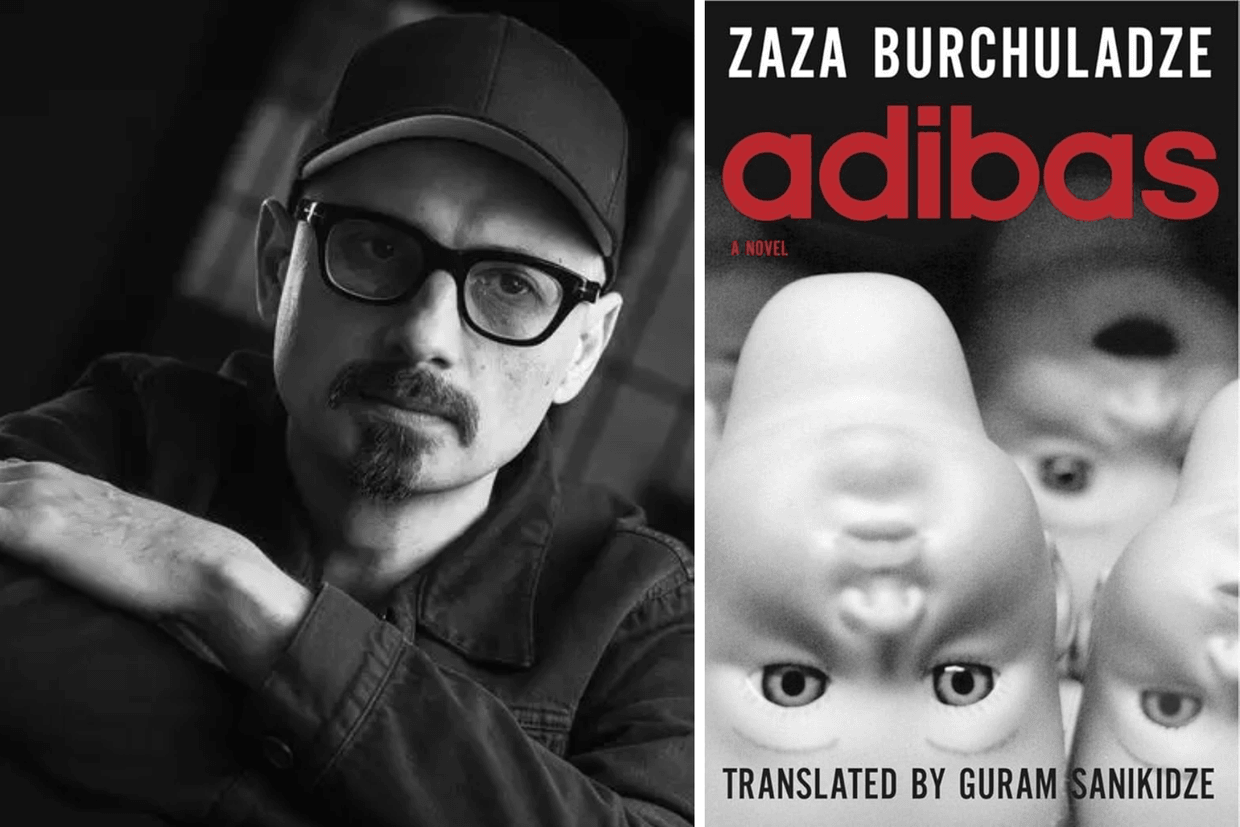
Zaza Burchuladze began writing Adibas on 8 August 2008 — the day rumours of Russian tanks entering Tbilisi first spread. He would later claim that war was the strongest stimulant he had ever found. The novel that emerged from that charge of adrenaline is slim, corrosive, and set in a sweltering Tbilisi that is doing its best to pretend nothing is happening.
Like its title — a bootleg simulacrum of Adidas — Adibas depicts Georgia’s desperate attempt to imitate the West, which is an accurate enough portrait of the country at that moment in time. With its deliberate superficiality, explicit sex scenes, name-dropping, and niche cultural references, the novel was designed to shock and scandalise.
When it came out in Georgia, it did just that. Yet even so, shock is a strategy that requires precise calibration, and Burchuladze occasionally miscalibrates it. In his eagerness to appear edgy, he overdoes his characters.
What saves Adibas is the form. Short chapters arrive as Skype chat logs, horoscopes, poems, chants; one bears unmistakable traces of Samuel Beckett. At only 110 pages, the book contains multitudes. The war, which surfaces now and then, is only background noise — a news snippet, a rumour, a gossip. It is happening, but Burchuladze’s urban hedonists are too aloof, too sheltered, too numb, too thoroughly consumed by consumer culture to know or care.
When Burchuladze stops straining for effect, genuinely memorable scenes emerge. The best is a new khinkali restaurant called Blue Velvet — a Lynch-inflected Tbilisi eatery that houses everyone under one roof: politicians and military brass, Botox Barbies and widows of thieves-in-law, foreign correspondents and Tbilisi bohemians high as kites. The scene works because it is the one moment in the novel where every stratum of Georgian society occupies the same frame simultaneously and none of them are looking at the war.
What makes Adibas genuinely interesting to a reader in 2026 is what it intuited — perhaps unwillingly — about the failure to be present to catastrophe, a failure that feels even more acute in the age of social media. There is a scene where a television screen shows a bloodied woman lying on the ground, pleading for help, a house and vehicles burning behind her — and running beneath the image, a scrolling bank advertisement offering entry into a competition for a new Mercedes if you open a deposit account. It is a precise image of how modern humans now experience war: in 15-second intervals, squeezed between a recipe reel and a fashion influencer's luxury haul. War crimes occupy the same attention spans as skincare tutorials and vanish at the same speed.
In the years since the novel was published, the world has watched — via glowing rectangles held at arm’s length — the siege of Aleppo, the bombing of Mariupol, the levelling of Gaza, and countless other catastrophes, each competing for bandwidth alongside product launches and celebrity gossip. The wars arrive in the feed. They are real, and then they are content, and the distinction collapses faster each time. Burchuladze’s characters at least had the honesty of their indifference.
Adibas is, at its core, a novel about simulation — and in the end, its melancholy runs deeper than its comedy. Burchuladze’s disenchanted characters reach for Western culture not because it will save them, but because it is there. The Amélie references, the Glenn Gould, the Aphex Twin — these are not the signs of a cosmopolitan sensibility. They are the signs of a man wearing someone else’s cultural inheritance on borrowed time, aware at some level that it does not fit.
Adibas. Not Adidas. Close enough, but never the original.
Book details: Adibas (2009) by Zaza Burchuladze, translated into English by Guram Sanikidze for Dalkey Archive Press in 2013. You can find the book on major retailers such as Amazon.