4.5/5★
Georgian director Irakli Kvirikadze’s 1976 film turns a drinking tradition into a portrait of a society trapped in itself.
Anara does not really exist on any Georgian map. When Irakli Kvirikadze made the film Small Town of Anara (Qalaqi Anara) in 1976, he invented a place that is nowhere and everywhere at once. It is immediately recognisable to any Georgian eye, and just as immediately, quietly absurd.
I had never heard of this film before Projection 24 chose it as one of the first titles in their project tracing the ‘origins of contemporary Georgian film’. Even with a stellar cast including Sesilia Takaishvili, Rezo Esadze, Kakhi Kavsadze, Erosi Manjgaladze and others, I had never seen it listed in retrospectives or caught it on television. And yet, within its first 10 minutes, it caught my attention.
One of the opening scenes does the work of an entire act in a single image. The head of the Toroshelidze family wakes up slowly and heavily, with the deliberateness of a man who has always known the room belongs to him. Behind him, hung on the wall like a religious icon, is an enormous wine horn, dwarfing the room. When he leaves the room, almost immediately he dies — killed, somehow metaphorically, by a basketful of feathers.
His son Varlam (Rezo Esadze) inherits the horn and the tradition attached to it. Varlam’s father earned it the only way anyone could: by drinking it to the bottom in a single sitting at a supra. Ever since, men with ambitions and strong stomachs had been coming to his house to try and take it from him. None succeeded. Now, standing over his father's coffin, Varlam is told by everyone around him that he has to continue the tradition.
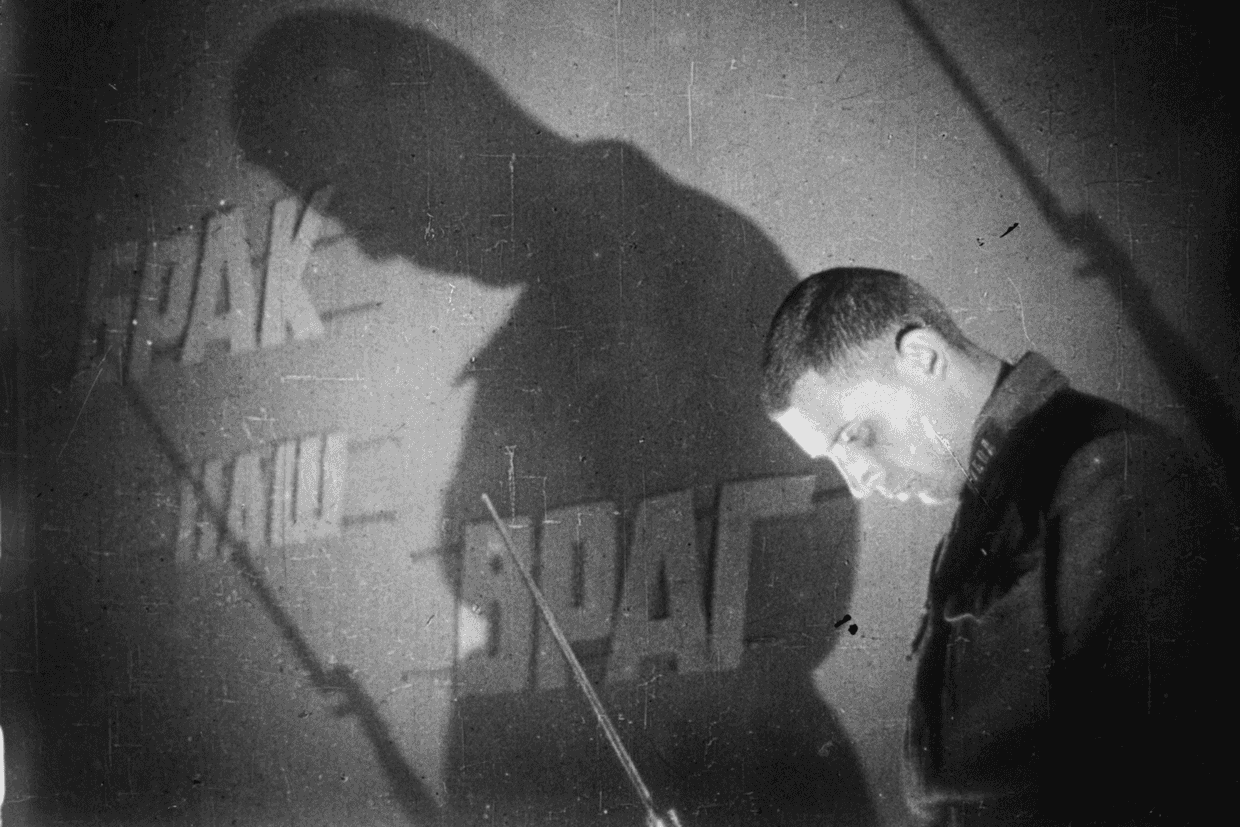
Esadze’s face is one of the great comic instruments of the film. The camera pursues his enormous moustache and wide pale blue eyes relentlessly, filling the frame with close-ups timed to land exactly where the movie needs them. His powerlessness is total and yet somehow dignified. He endures the challengers who come one after another, each causing a different kind of problem. One is offended by the size of the horn. Another panics and sleeps in Varlam’s house for days, snoring. A third follows the ritual and drinks six glasses of wine before the horn, as tradition demands, but never makes it any further. Somewhere between the fifth and sixth glass, he becomes convinced there is a bear loose in the house, reaches for a gun, and nearly turns the Toroshelidze household into a crime scene.
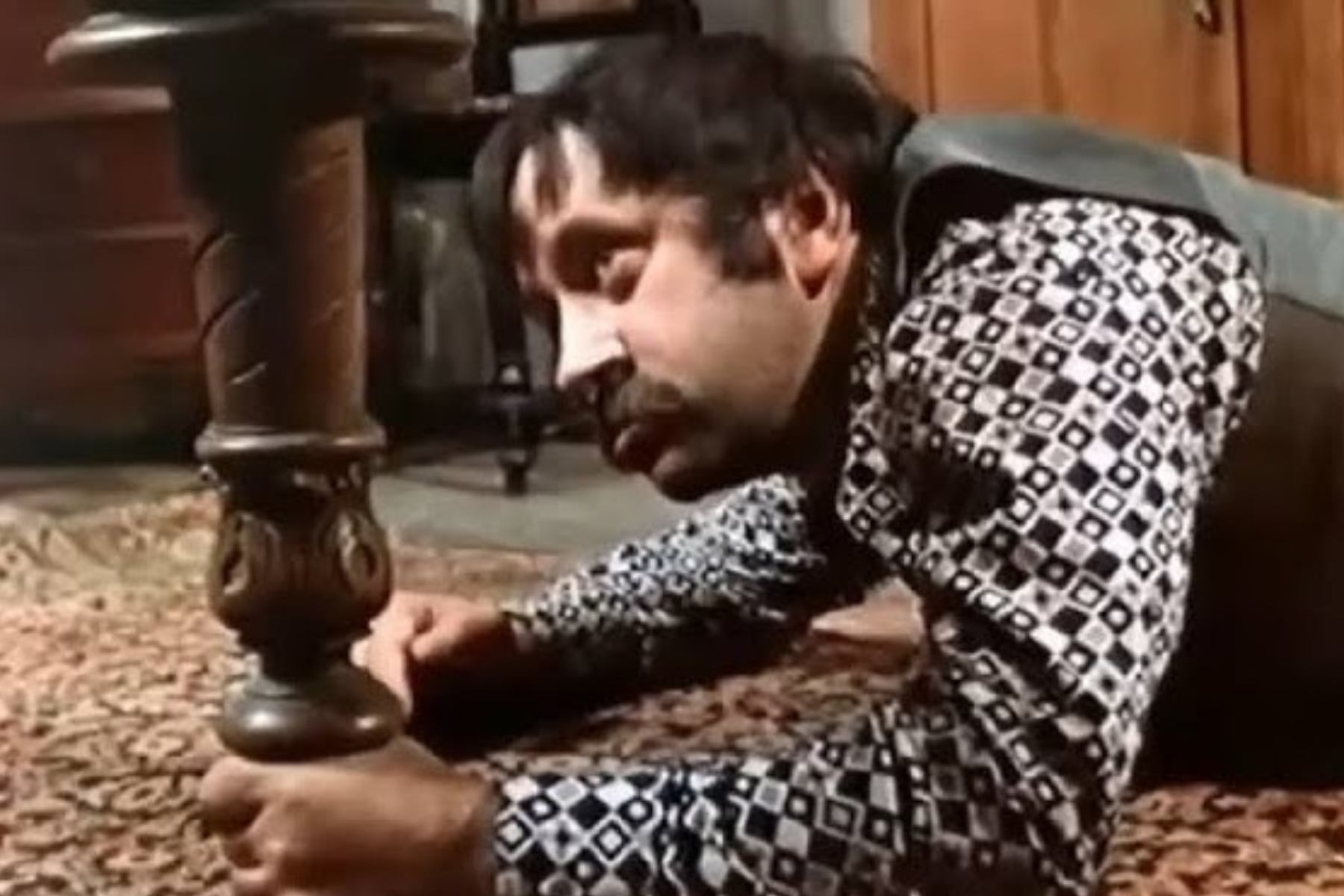
By this point, the horn has stopped being an object, instead a problematic condition to life. Varlam no longer wants challengers at his house; at one point, exhausted, he says that everyone who is thirsty for wine in the whole of Anara ends up at his door.
The women of the house, Varlam’s mother and aunt, are a constant, watchful presence. They do not drive the plot, but they enforce it. It is they who name the tradition and remind Varlam what is owed. They are not victims of the tradition so much as its most faithful custodians. This is, perhaps, the film’s sharpest observation about how inherited rituals sustain themselves.
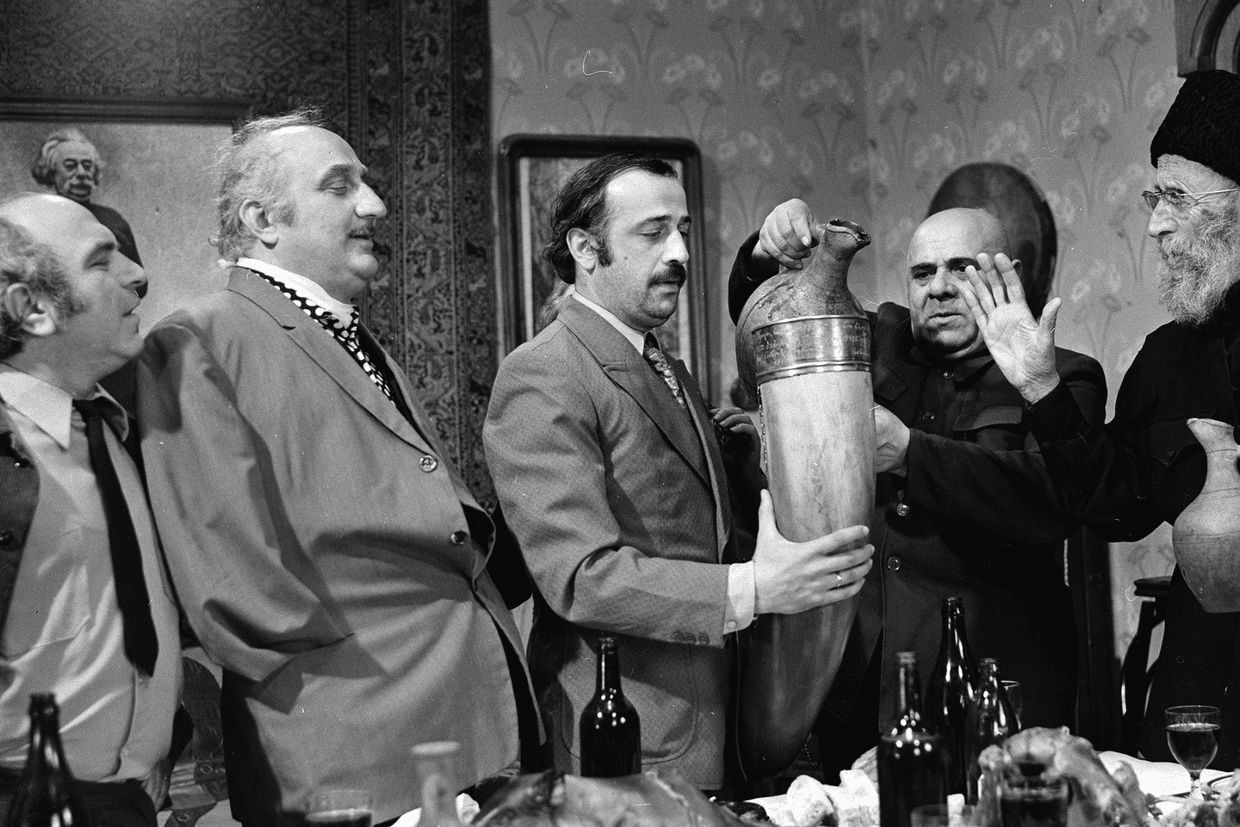
At one point, when Varlam is away from home, some fraudsters arrive. Three men show up in disguise — one has a hidden container strapped under his clothes — and stage a performance of drinking the horn. They walk out with the horn. When Varlam returns home, while he is not unhappy with the news, his relatives tell him the family’s dignity has been stolen, forcing him to go and win it back.
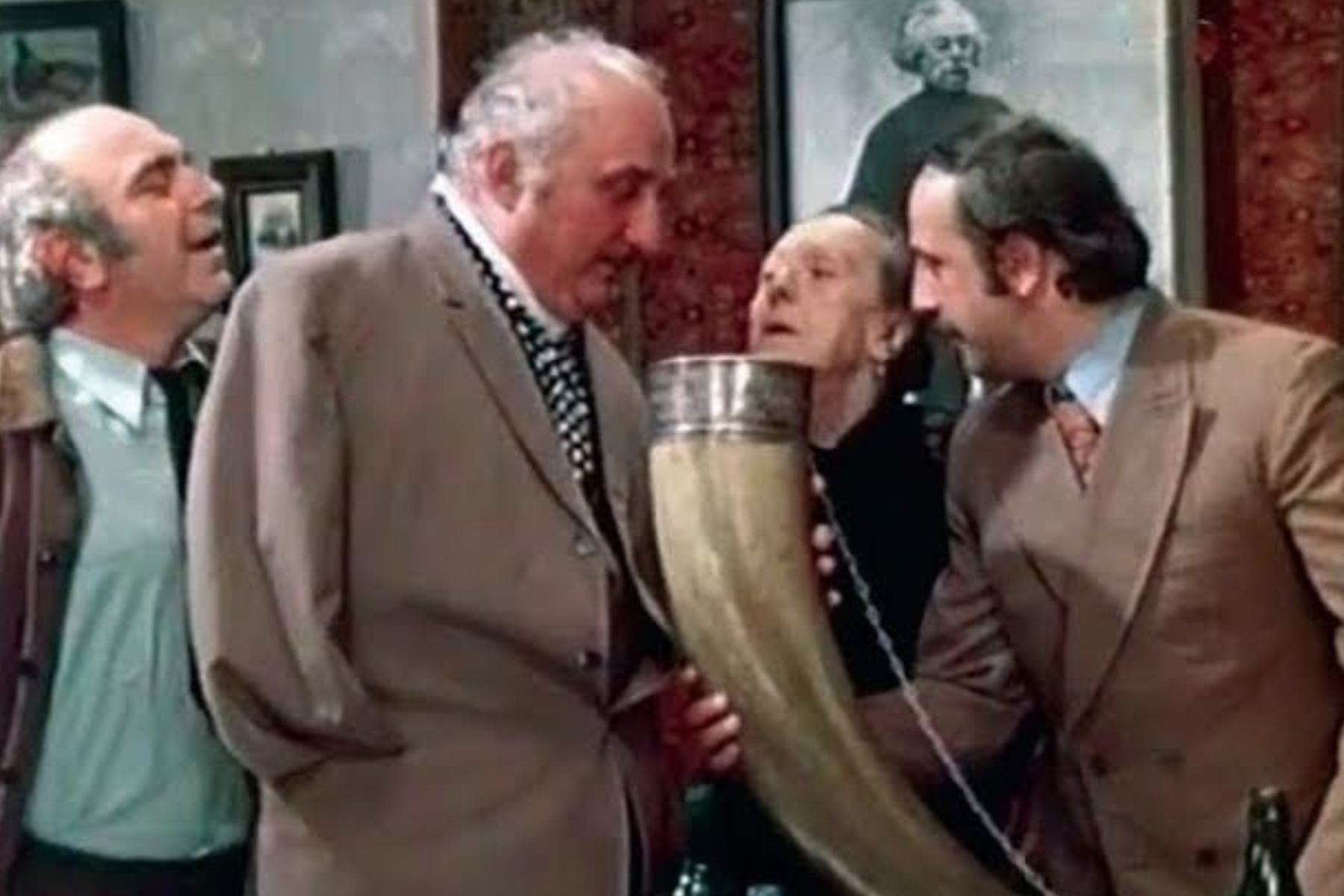
It is worth highlighting who Kvirikadze has chosen for these roles. All the challengers are big, tall men, the stereotypical Georgian tamada type. Varlam is nothing like that — he is short, looks honest, and carries himself differently from everyone around him. When he finds out about the horn, he erupts: ‘I am my father’s dignity, not that horn’. The film knows he is right, yet it sends him off to retrieve the horn anyway. In Anara, as in the late Soviet Union, being correct changes very little about what you are required to do.
Varlam is also an actor who performs regularly at the local theatre. Every scene he plays on stage somehow mirrors what is happening to him at home. The best moment comes on the day the fraudsters take the horn. Varlam is mid-performance, playing a raven with his arms wide, flying across the stage. In that suspended instant, he whispers to his scene partner: ‘Congratulate me, they took the horn’. The flying represents the relief he feels.
Nana Jorjadze, herself later a celebrated Georgian director, then a 22-year-old intern on set, spoke after the Projection 24 screening about what Kvirikadze was reaching for. The director wanted to show, she said, how every tradition in the Soviet Union had been deformed into something extreme. What began as living custom calcified into obligation, then burden, and finally absurdity. She also mentioned that the horn itself was never real — just a prop.
Georgian art critic, journalist, film historian Gogi Gvakharia has written that the mustachioed tamada with a drinking horn was not an ancient Georgian archetype at all, but a Stalin-era invention, a Soviet cultural stereotype imposed from outside that, over time, was laundered into something people began calling folk tradition. Seen through that lens, the horn is not heritage, it is a costume. And what the film shows, with remarkable precision and very little bitterness, is how completely a costume can come to feel like skin. Gvakharia also notes that the film was released in deliberately limited distribution, only in small cinemas and film clubs, and received almost no positive coverage in the central Soviet press, which also helps explain why it remained quite unknown in its own country despite receiving a critics’ prize at the 1978 Locarno Film Festival.
Kvirikadze clearly understood that the distance between farce and anxiety is narrower than it looks. The camera throughout the film is restless, rarely still, always pressing closer into a grimace or a blink. The instrumental score is intense, pulling scenes that could simply be funny into something more anxious.
While it is best to watch the film without knowing what happens to the horn in the end, it is clear the film’s main takeaway is the weight of the horn — it is something problematic to own but also to lose. A clear example of how a false image can determine your entire life, just as the Soviet ideals affected so many in real life.
Film details: Small Town of Anara (1976), directed by Irakli Kvirikadze. The film was screened by Projection 24 at the Haraki Theatre on 25 April 2026.