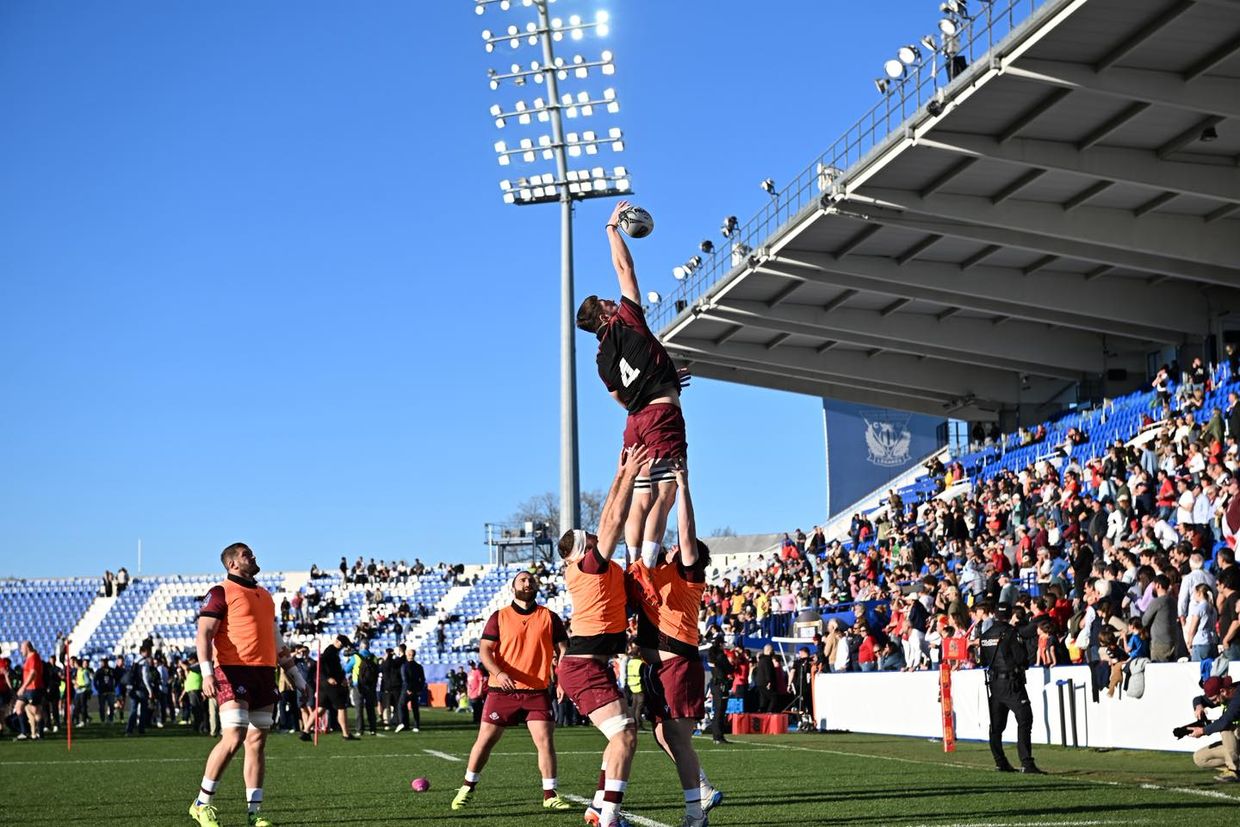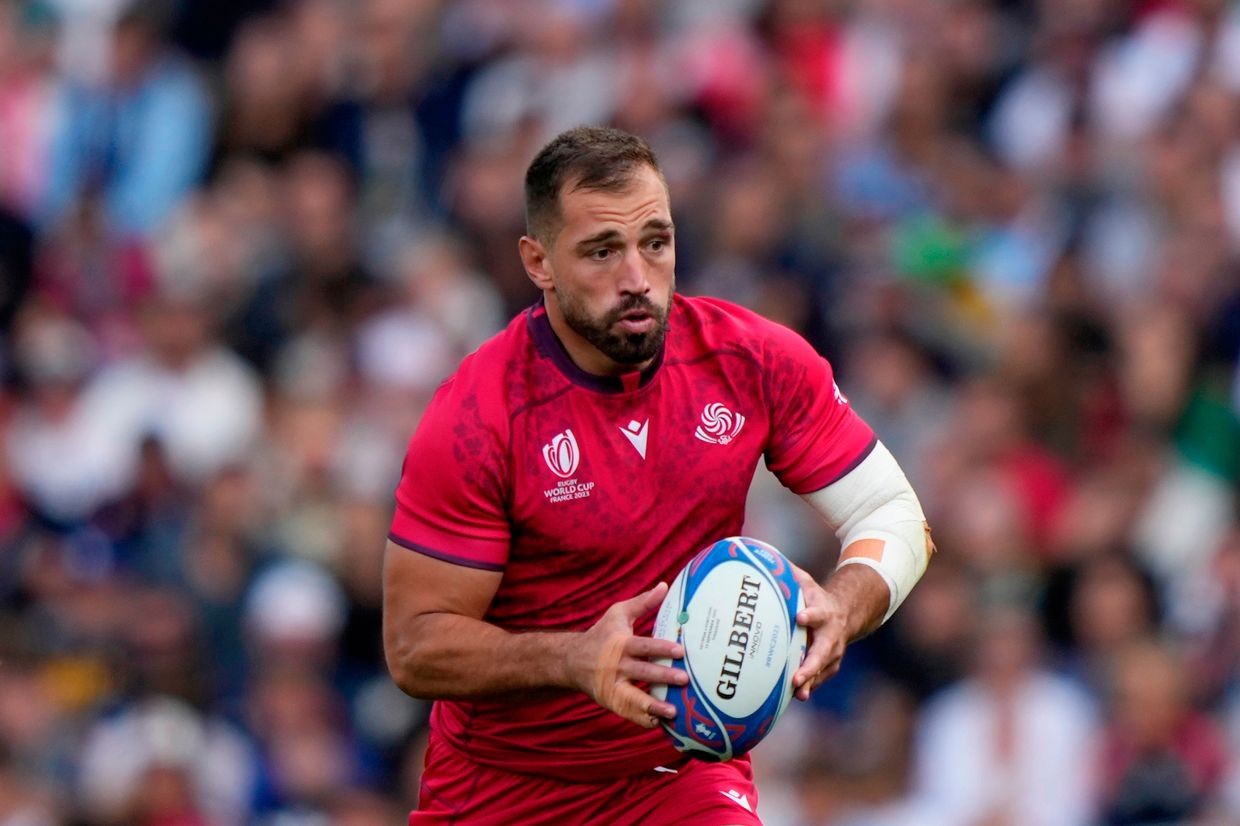
Merab Sharikadze, the former captain of the Georgian national rugby team, has been handed an 11-year ban in connection with substituting a urine sample during a doping test. Several other Georgian rugby players, as well as a former team doctor, were also banned for shorter periods over similar violations of anti-doping regulations.
The parallel investigation which led to the heavy sanctions was conducted by World Rugby and the World Anti-Doping Agency (WADA). World Rugby described it as ‘the most extensive anti-doping investigation ever undertaken in rugby’ in Tuesday’s statement.
The statement named ‘involvement in urine sample substitution over an extended period prior to Men’s Rugby World Cup 2023’ as the reason for the sanctions. According to World Rugby, the investigation was triggered ‘when irregularities in urine samples were identified’.
During the course of an investigation, World Rugby’s operating hypothesis was that the urine sample substitutions were conducted to conceal the use of performance-enhancing substances — something could not be proved by evidence.
‘In parallel, there was credible evidence to support the players’ assertions that the urine sample substitutions occurred to conceal the use of non-performance-enhancing substances (namely, cannabis and Tramadol)’, the organisation said.
According to the BBC, while cannabis is on Wada’s list of banned substances, its use is only prohibited during competition. The broadcaster noted that Tramadol, which is now similarly sanctioned, ‘was not banned at all’ at the time of Georgia’s offences.
‘Their urine swaps all took place to evade detection out of competition’, it reported.
Alongside with Sharikadze, anti-doping rule violation sanctions have been imposed against players Giorgi Chkoidze (six years), Lasha Khmaladze (three years), Mirian Modebadze (three years), Otar Lashkhi (three years), and Lasha Lomidze (nine months).
Nutsa Shamatava, who was the team’s chief doctor, received a nine-year ban.
When WADA first reported the doping scandal in March — that time without mentioning names — the Georgian Rugby Union said that none of those involved in the case were still playing or working for the Georgian national team after the 2023–24 season.
 OC Media
World Rugby noted that it investigated the Georgian Rugby Union alongside players and staff, to ensure that ‘any potential involvement’ was addressed. Although it found no direct wrongdoing of the union under the relevant regulation, World Rugby issued a misconduct charge.
In the Tuesday statement, the Georgian Rugby Union emphasised that it agreed with World Rugby’s decision, accepting a financial penalty and committing to implement reforms in anti-doping education.
‘From the very beginning of the process, the Georgian Rugby Union has fully and transparently cooperated with World Rugby. As part of the anti-doping education reform, intensive work is already underway, and stricter preventive measures have been implemented’, it added.
In a November 2025 interview with Setanta Sports Georgia, 32 year-old Sharikadze spoke about the doping scandal. He confirmed that his sample had been used in place of other players’ samples.
‘One of the people asked me, someone I trusted. It’s ironic that, as it turns out, they didn’t even need it — but how would one prove that? If they had submitted their own sample, they wouldn’t have been disqualified’, he added.
According to Sharikadze, when he was summoned to the Georgian Rugby Union in July 2024 and informed about the investigation, he could hardly imagine what was awaiting him.
‘I didn’t think this could be treated as such a serious offence, especially since I didn’t use anyone else’s urine. My clean sample was used by someone else, he said.
Sharikadze added that it was after being called to the Georgian Rugby Union that he stepped away from the game, effectively being forced into early retirement.
‘I was responsible for many things in rugby, and suddenly I found myself furthest away from it all. My story should not have ended like this; in one word, I would call it disappointment’.
Yousef Bardouka