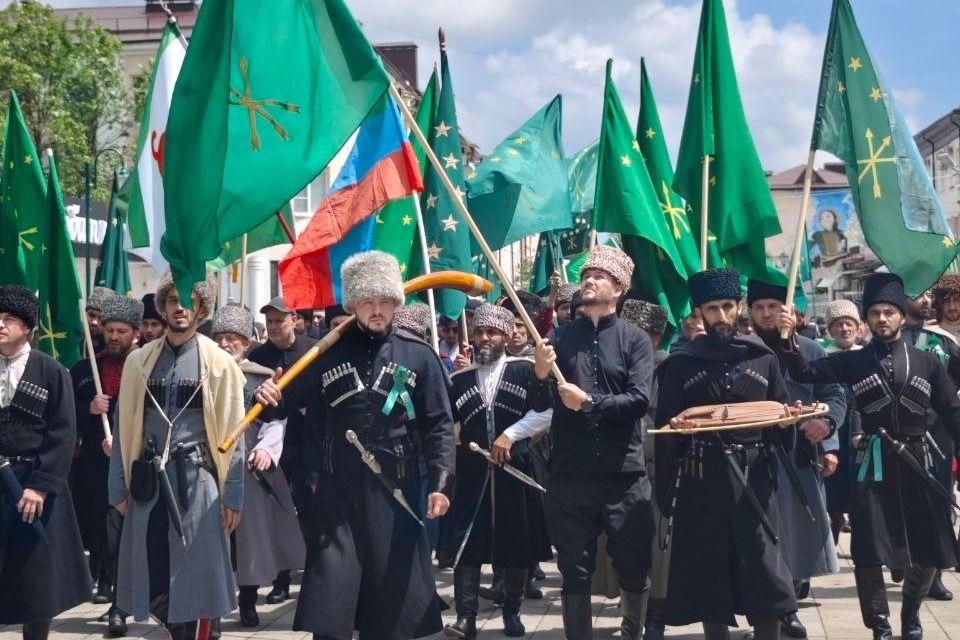
Circassians in Nalchik, Kabarda–Balkaria, have held their traditional march commemorating the end of Russia’s 19th century conquest of the North Caucasus and the Circassian Genocide, despite having been warned against doing so ahead of time.
The Day of Remembrance for the victims of Russia’s conquest of the Caucasus is observed annually on 21 May in North Caucasian republics with Circassian populations — Kabarda–Balkaria, Karachay–Cherkessia and Adygea — as well as within the larger Circassian diaspora abroad. The date marks the end of the Caucasian War fought by the Russian Empire against the peoples of the North Caucasus.
The date is also remembered as the memorial date for the Circassian Genocide, which resulted in the expulsion and death of hundreds of thousands of Circassians from the Caucasus. Russian authorities do not officially recognise these events as genocide.
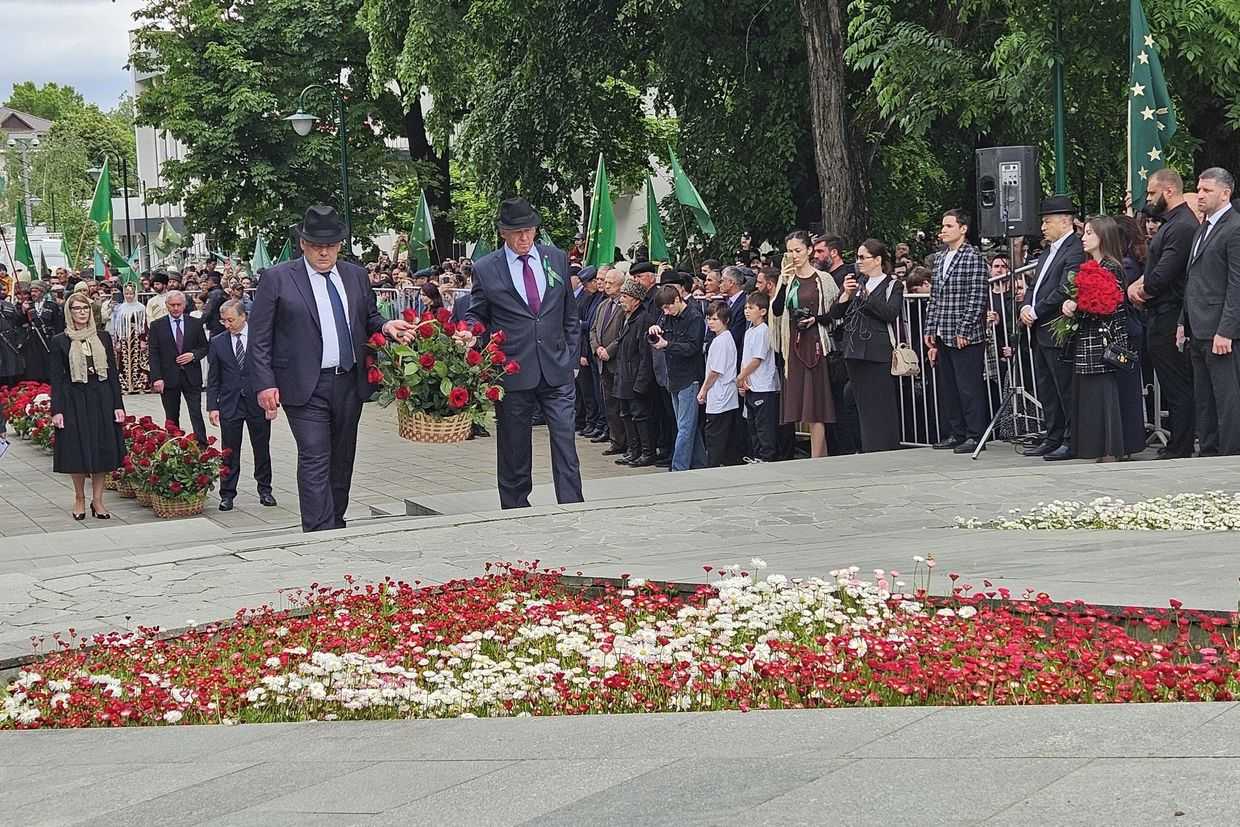
This year marks the 162nd anniversary of the end of the war. Around 1,000 people took part in the march in Nalchik. They walked along the entire avenue from the railway station to Concord Square, before joining participants at a rally near the Tree of Life memorial.
The march passed without incident, and participants remained exclusively on the pavements, according to the independent Russian media outlet Caucasian Knot.
Last year, during a march with Circassian flags marking the 161st anniversary of the end of the Caucasian War, at least eight people were detained in Nalchik. They received administrative arrests ranging from three to 10 days on charges of participating in an unauthorised demonstration and obstructing traffic.
 Elizaveta Chukharova
This year, on the eve of the commemoration, participants gathered near the Tree of Life memorial in Nalchik and lit 101 candles — a symbolic number signifying the number of years Circassians fought the Russian Empire between 1763–1864.
In the lead up to Thursday, residents of the republic began receiving calls from local police officers and other law enforcement officials. They were summoned to police stations to receive official warnings against participating in the march. The documents cited legislation governing public assemblies and warned of possible administrative and criminal liability for participation in unauthorised mass events.
Elizaveta Chukharova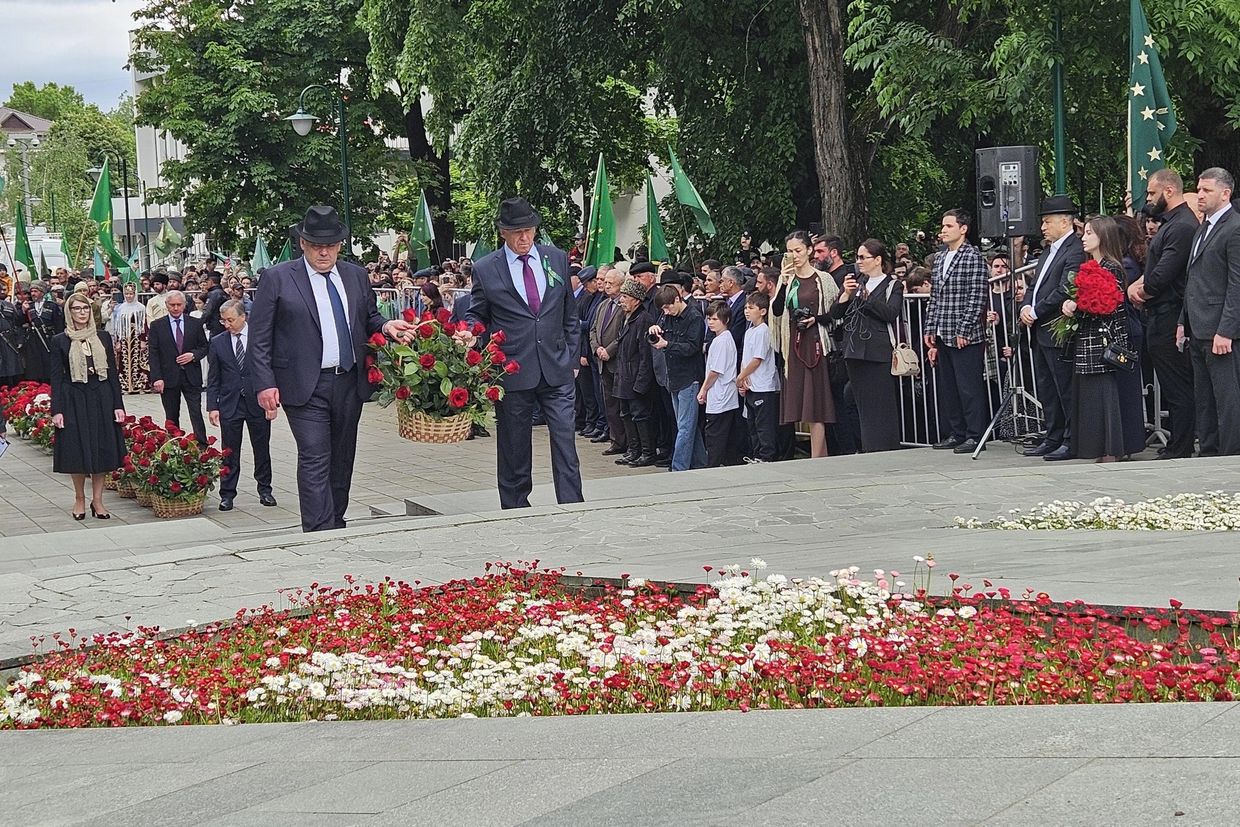
Public figure Azamat Shormanov told Caucasian Knot that he had refused to meet with a local police officer and accept the document.
‘I asked whether I had violated any law and why they wanted to issue me with a warning. He said I had not, and I refused to meet him, asking instead for an official summons if there were any claims against me, in which case I would come together with my lawyer’, Shormanov said.
According to him, the police officer admitted he was acting under orders from his superiors.
‘He said he was under pressure from above to meet me and hand it over personally. Last year they also tried to do this — officers from Centre E (Centre for Countering Extremism) called me, and afterwards they sent a local district officer to my parents’ home. It is a form of psychological pressure through relatives’, the activist said.
Earlier, OC Media reported that 36 public organisations had appealed to the Kabarda–Balkaria Head Kazbek Kokov demanding that the authorities ensure the peaceful conduct of commemorative events. The authors of the appeal stated that pressure on participants in the march had become a systematic practice in recent years.
Following this, on 18 May, the International Circassian Association published a commemorative events programme pre-planned with the republican government. The statement noted that ‘for all those wishing to participate, a mourning march along the city pavements to the rally at the Tree of Life monument will be organised in compliance with all necessary safety measures’.
In 2020 and 2021, mass mourning marches were not held because of COVID-19 restrictions. Later, the republic’s authorities began citing security concerns and the ‘special military operation’ in Ukraine — the term Russia uses to describe its full-scale invasion of Ukraine. Initially, a horseback procession was banned, and later even a pedestrian march along Nalchik’s central avenue was prohibited.
On 21 May, commemorative events are held not only in the North Caucasus, but also in countries with large Circassian diaspora communities — including Turkey, Jordan, Syria, Germany, France, the US, and Israel. According to various estimates, between three and six million descendants of people from the North Caucasus — the majority of whom are Circassian — live in Turkey alone.
In a statement marking the commemorative date, Kokov described the conquest of Caucasus as ‘one of the most dramatic periods in the history of the Circassian people’.
‘The Caucasian War led to enormous human losses, forced resettlement, and survival in exile for a significant part of the Circassian people. On this day, we bow our heads in memory of all victims of this terrible war’, the statement said.
A separate statement issued by the Head of Adygea, Murat Kumpilov, said that the memory of Circassians who died or were displaced had been preserved across generations.
‘I am convinced that, by preserving the memory of the past, including its tragic pages, the people of Adygea will continue, together with all the peoples of our vast country, to contribute through their labour and military achievements to the prosperity, strength, and greatness of our large Motherland’, Kumpilov wrote.
In Cherkessk, the traditional mourning rally was held at the memorial to the victims of the Caucasian War on Gutyakulov Street. Flowers were laid and a minute of silence observed. Local social media pages reported that representatives of all the peoples of Karachay–Cherkessia, public organisations, clergy, government bodies, youth groups, and local residents took part in the event.
Local administrations across the region also reported commemorative events. In most cases, these involved laying flowers at memorials.