Georgian Orthodox Church shortlists three candidates for next Patriarch — who are they?

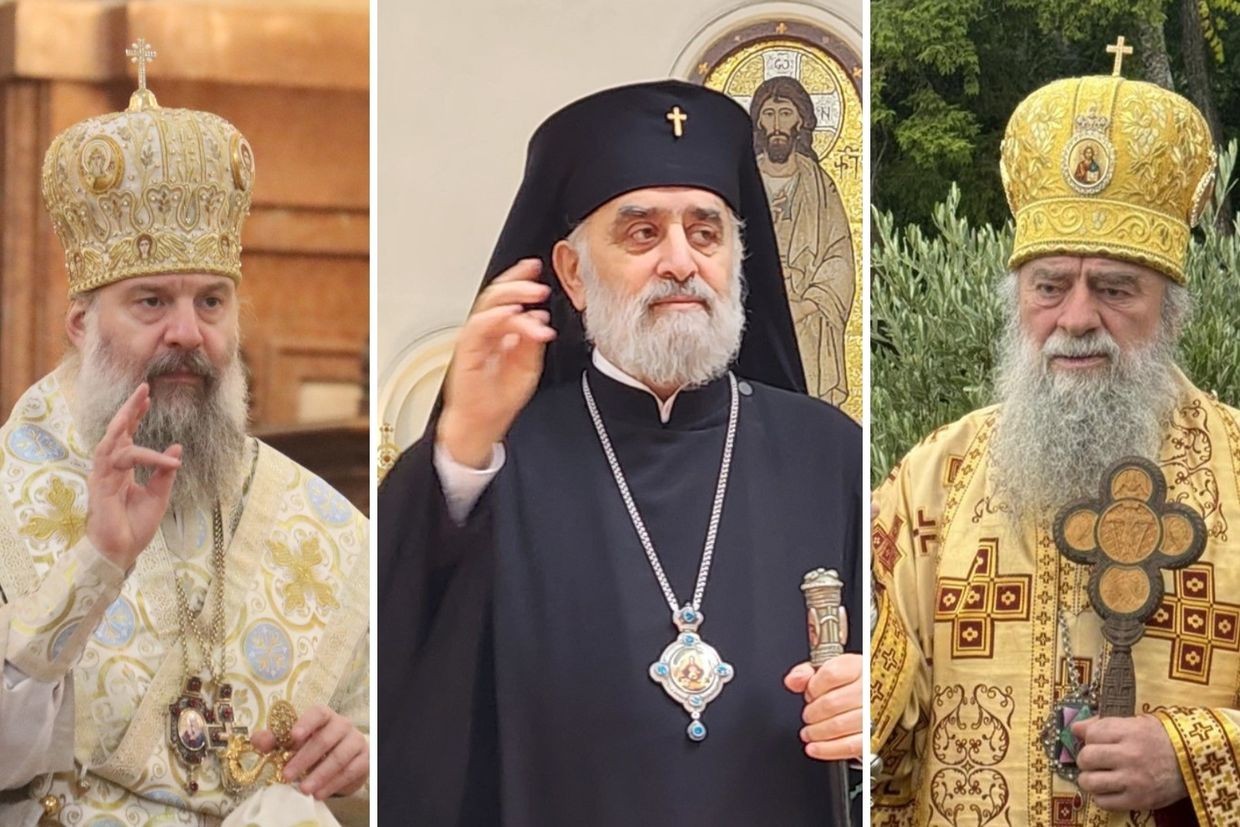
The Holy Synod of the Georgian Orthodox Church has shortlisted three candidates from within its ranks who will compete in the final vote to elect the next Patriarch. The highest number of votes went to Metropolitan Shio Mujiri — incumbent of the patriarchal throne.
The high-ranking clergy who make up the Holy Synod — the Church’s highest governing body — held the crucial meeting on Tuesday, with 38 of its 39 members in attendance. This was part of the procedure outlined in the Church’s statute, which stipulates that the bishops must first select three candidates who will proceed to the ultimate elections.
According to the session protocol, Mujiri received the highest number of votes — 20. He was appointed in 2017 by the late Patriarch Ilia II as locum tenens — the designated incumbent who assumes Church governance in the event of the Patriarch’s resignation, incapacity, or death.
Metropolitans Grigol Berbichashvili and Iob Akiashvili emerged as the second and third candidates, each receiving seven votes. Bishops Grigol Katsia and Dositeoz Bogveradze received two and one votes respectively, and were thus eliminated from the race. One ballot appears to have been left blank.
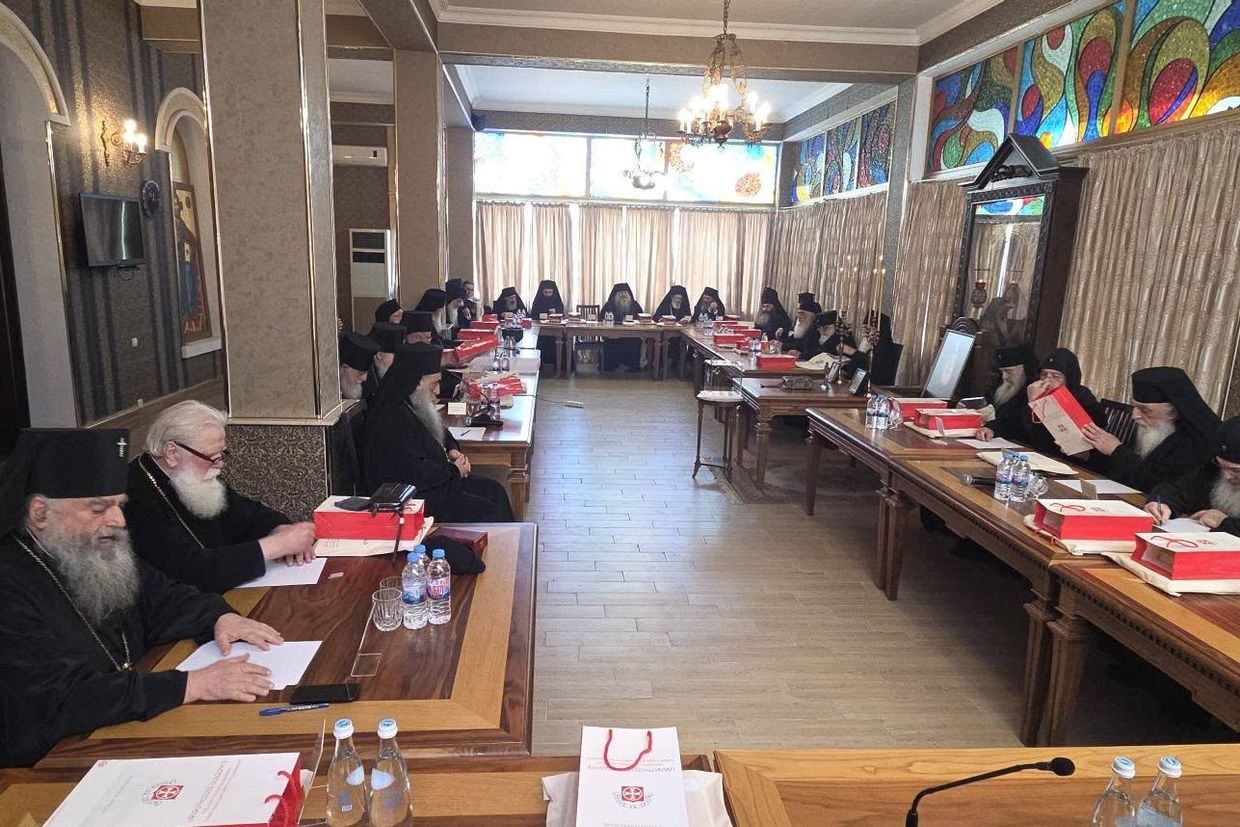
After the first stage, which is now over, the incumbent is required to convene an expanded Church council, at which the new Patriarch is to be elected.
The expanded council comprises both the hierarchs of the Holy Synod and representatives from across the Church, including defined numbers of clergy and lay delegates from each diocese, in addition to delegates from monasteries, theological academies, and seminaries.
Despite this expansion, however, the right to vote is reserved exclusively for the Holy Synod hierarchs, leaving all other participants with a merely consultative role. This means that only the 39 bishops will elect the next Patriarch.
Ilia II, the longest-serving head of the Georgian Orthodox Church, died on the evening of 17 March in the intensive care unit, leaving behind a 48 year-long legacy.
Discussions soon followed who could replace him.
 Mikheil Gvadzabia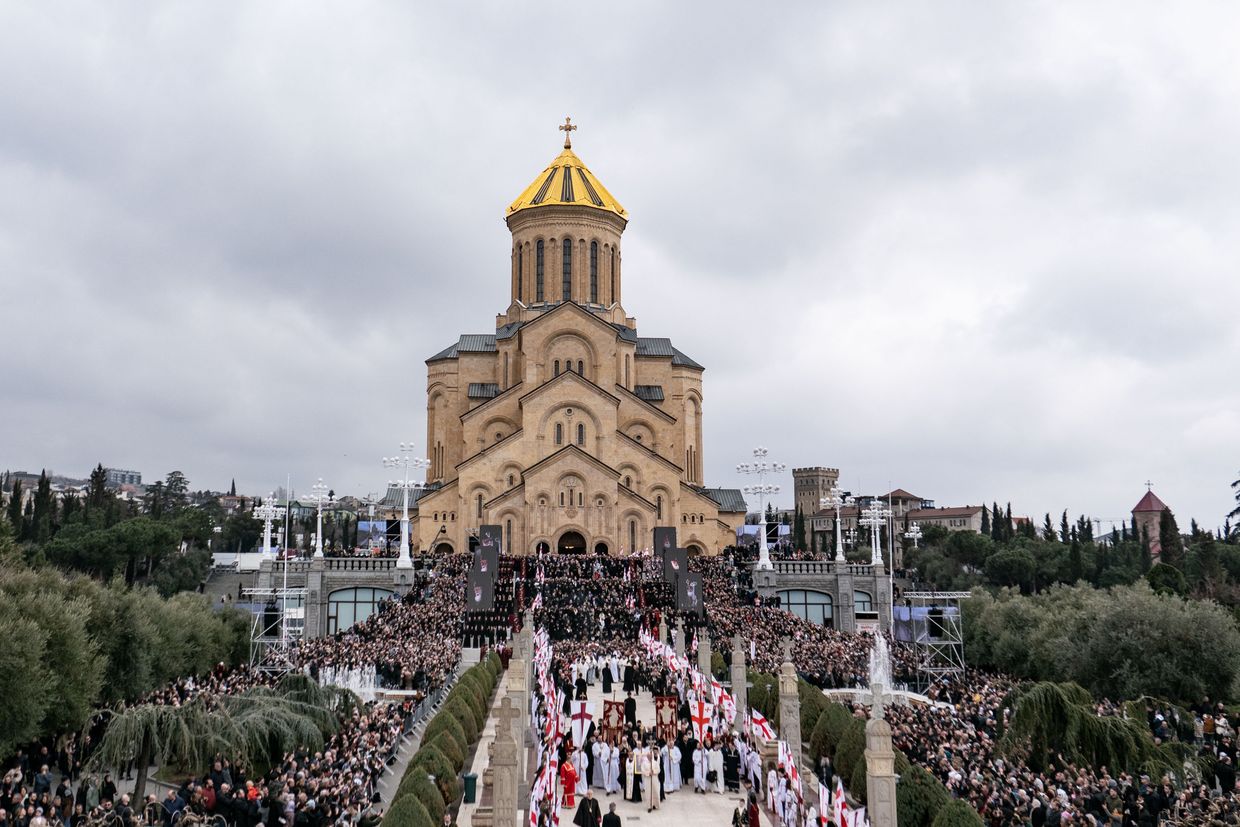
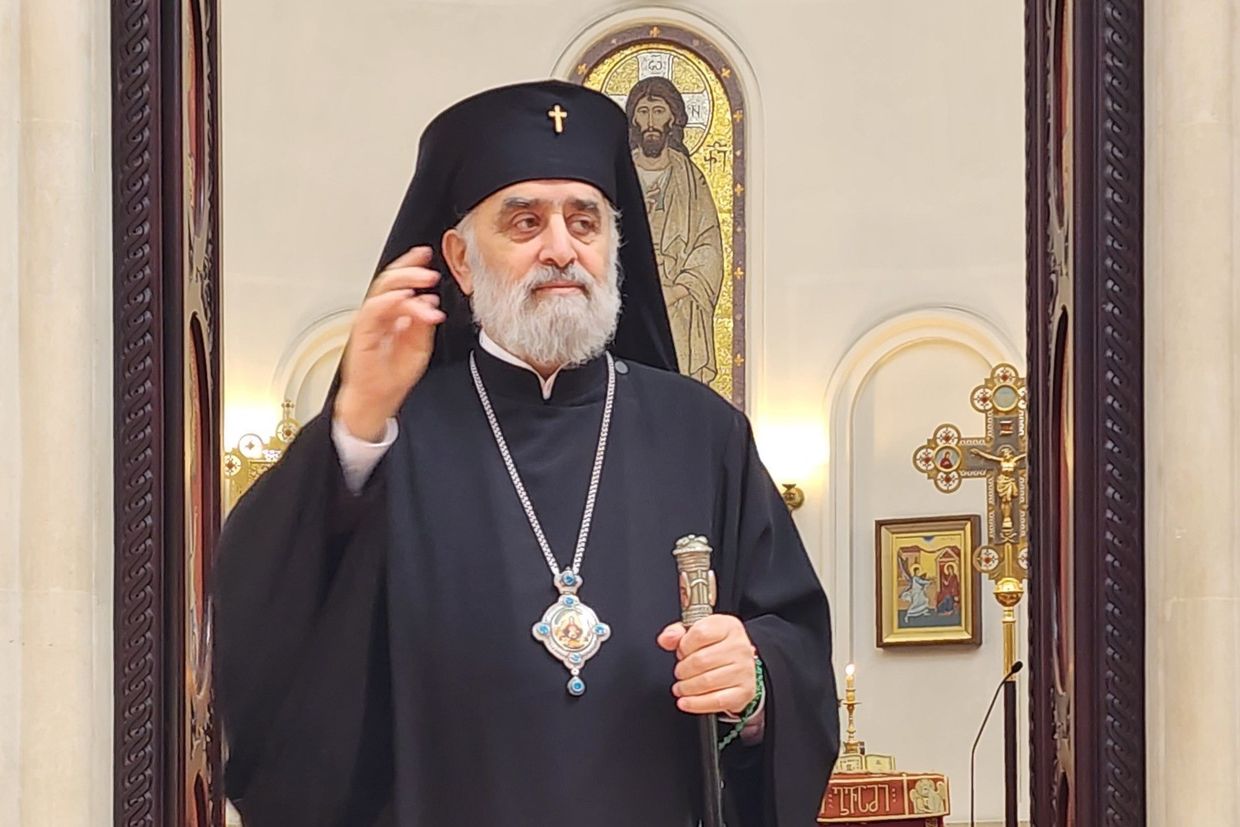
Incumbent Shio Mujiri
Mujiri, 57, serves as locum tenens and the Metropolitan of Senaki and Chkhorotsku in western Georgia, as well as of New Zealand.
According to the Patriarchate’s website, after finishing secondary school, Mujiri enrolled at the Tbilisi State Conservatoire. In 1991 he was ordained as a novice, and two years later he was tonsured as a monk and given the name Shio. He was consecrated as a bishop in 2003, elevated to archbishop in 2009, and became a metropolitan the year after.
Mujiri received his theological education both in Georgia and Russia, where in 2015 he defended his dissertation at Saint Tikhon’s Orthodox University of Moscow.
Mujiri gained broad public recognition outside his diocese mainly after 2017, when Ilia II appointed him as the incumbent, nine years before his death. Mujiri’s perceived lack of involvement in the internal scandals that had increasingly affected the Church were among the reasons cited by some observers as a factor in his selection.
In the years that followed, Mujiri’s visibility — and, in the view of observers, his influence over internal Patriarchate affairs — grew, against the backdrop of a marked decline in Ilia II’s health.
Although canonical tradition does not consider the locum tenens the Patriarch’s successor or grant them any advantage in the election, Mujiri’s supporters have repeatedly portrayed him in social media and public statements as Ilia II’s chosen candidate, and therefore, the inevitable choice for Patriarch.
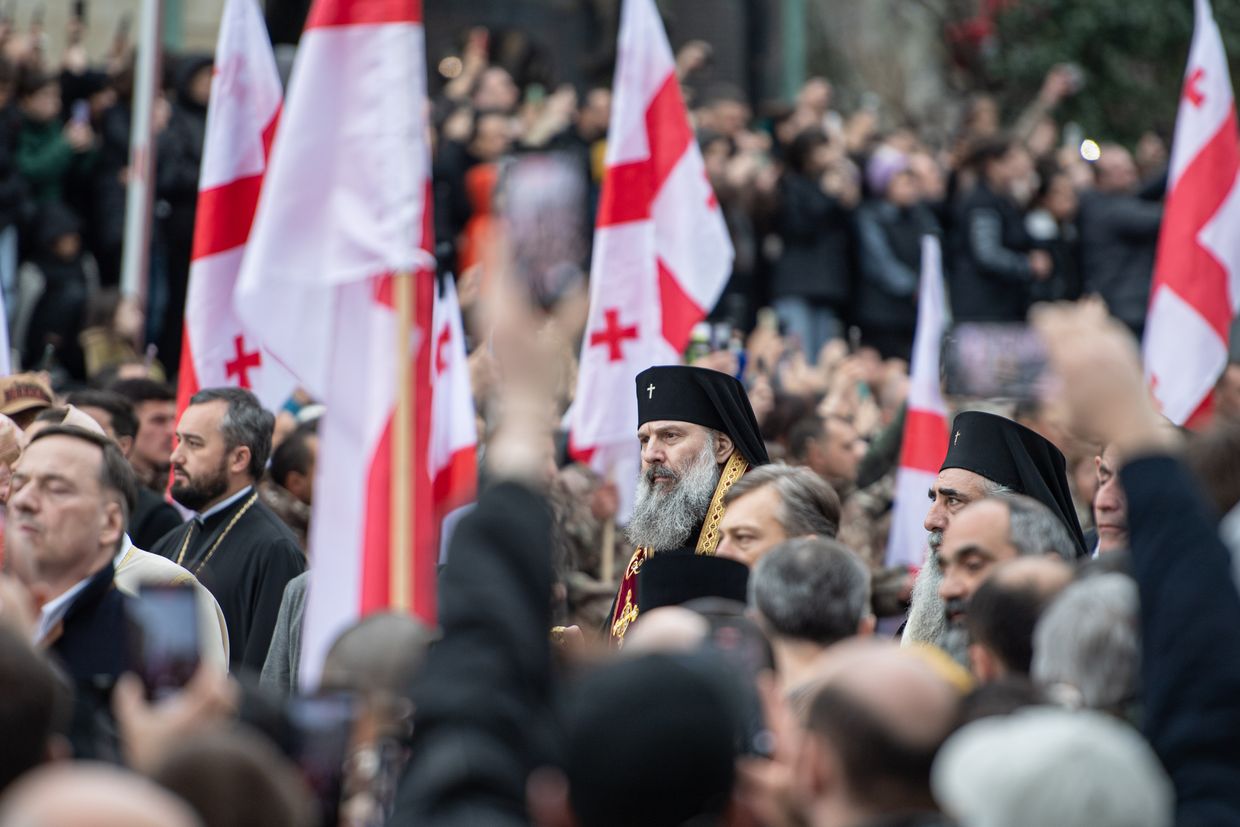
Some observers argue that, after being appointed as incumbent, Mujiri built ‘parallel structures’ within the Patriarchate to strengthen the group aligned with him. Critics have also accused him of steering the Church towards a greater alignment with the state and increasing support for the ruling Georgian Dream party and their policies.
Another controversy linked to Mujiri concerns alleged influence from the Kremlin-aligned Russian Orthodox Church, with some highlighting the timing of his appointment, which came three weeks after a visit to Tbilisi by Hilarion Alfeyev, a senior representative of Patriarch Kirill. Alfeyev’s meeting with Ilia II sparked questions about possible external pressure, which the Patriarchate has denied.
Mujiri himself said in 2017, responding to a question regarding his alleged links with Moscow, that it was ‘gossip and slander’.
While Georgian Dream leaders have avoided openly backing any metropolitan, pro-government TV host Gia Gachechiladze drew attention by claiming in March that Ilia II had effectively named Mujiri as his successor, and that any hierarch who does not withdraw in his favour would be a ‘traitor’. He later apologised for the statement.
Iob Akiashvili and his conspiracy-laden rhetoric
Metropolitan Akiashvili, 76, heads the Ruisi-Urbnisi diocese in Shida Kartli. Like all current members of the Holy Synod, he was elevated to the rank of metropolitan under Ilia II. Akiashvili also chairs the Patriarchate’s commission for the study and editing of liturgical books.
Akiashvili is well known to the public for his outspoken and sometimes conspiracy-laden statements about social and political issues concerning the country.
In the early 2010s, Akiashvili was a key clerical figure in the controversy surrounding biometric ID cards, describing the new document as one with ‘a mark of the Antichrist’ and ‘a hardship intended to be imposed on us to undermine and suppress our faith and religious beliefs’.
During the same period, in a 2011 sermon, Akiashvili cited a ‘scientific explanation’ which, according to him, aligned with ‘the prophecies of the Fathers’, claiming that in 2013 there would be ‘major solar explosions’ and that a ‘magnetic field would envelop all of humanity’.
During the early stages of the COVID-19 pandemic, in March 2020, Akiashvili described the pandemic as being ‘artificially imposed’ and stated that ‘psychotic media coverage’ was causing public anxiety, which he said was directed against faith. Later that year, he was hospitalised after contracting COVID-19.
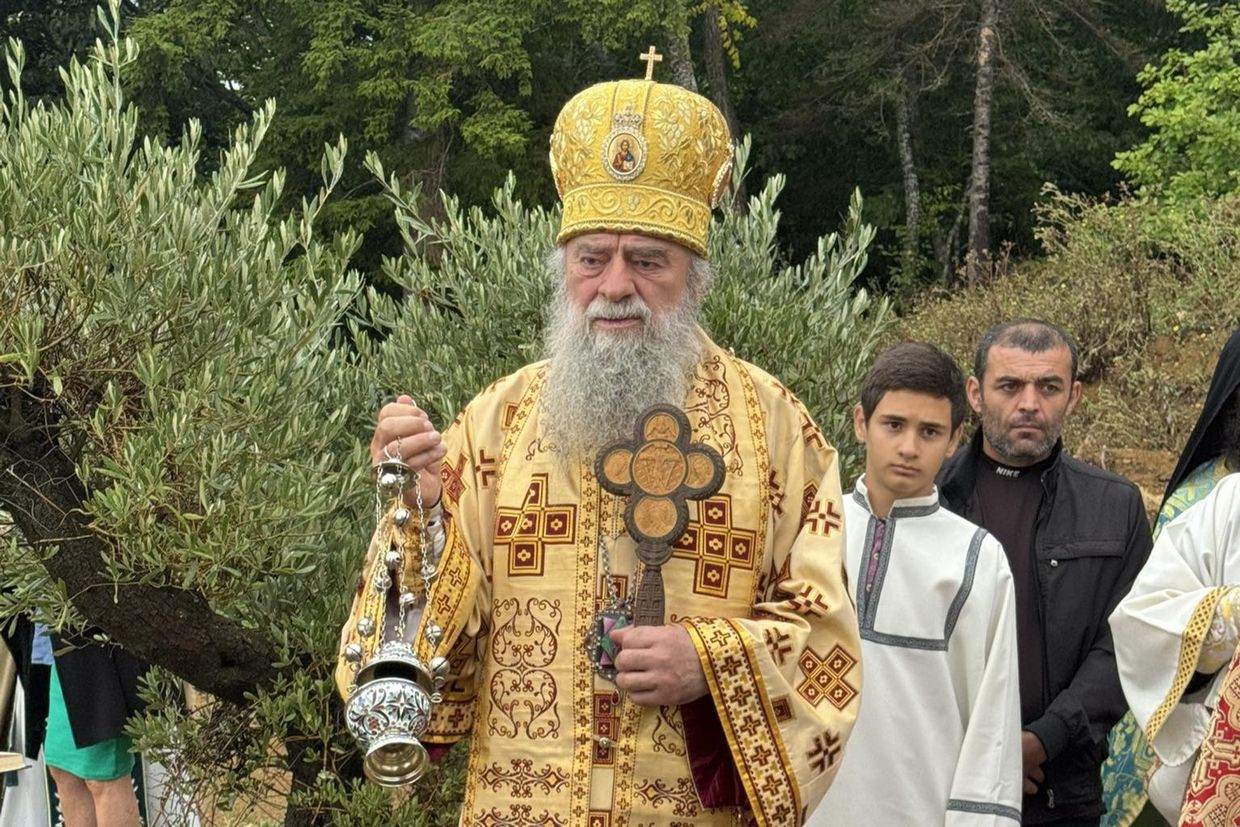
Akiashvili has on several occasions taken positions on both domestic and foreign policy issues, at times with noticeable variations in his rhetoric.
In the September 2008 issue of the religious journal Kvakutkhedi, which was published with his blessing, the 2008 August War was described as a punishment, suggesting that God did not wish Georgia to move closer to the West and would instead bless its entry into Russia’s sphere of protection. Akiashvili later distanced himself from these remarks, stating he had not approved them, and sharply condemned Russia.
In 2014, however, Akiashvili reportedly told the ultra-right Asaval-Dasavali newspaper that Russia did not ‘behave as a model Orthodox country’.
‘Russia has never treated us as a fellow Orthodox nation and has caused us great harm; it does not itself behave as a model Orthodox country. But I prefer a fallen Orthodoxy to a pagan and unbelieving American and a spiritually dead European’.
In 2010, the opposition to then-President Mikheil Saakashvili cited statements attributed to Akiashvili, condemning what he described as Georgia’s ‘spiritual occupation’, which was worse than the ‘physical occupation’ of Georgian territories by Russia.
Meanwhile, in 2024, when Saakashvili was already in jail under the Georgian Dream government, Akiashvili hinted at the possibility of Saakashvili’s release, stating that during Saakashvili’s rule ‘the Church benefited in a way it had not under any other government’, including through the transfer of land and buildings, as well as the construction of churches.
In November 2025, in response to a journalist’s question about violence against anti-government protesters, Akiashvili cited Augustine of Hippo, stating: ‘I have already said in general terms that if this government does not serve justice and truth, it is a band of brigands’.
Akiashvili supports the restoration of some form of monarchy in Georgia. In one of his recent sermons, he said that ‘a king would serve as a balancing force in the nation, bring peace, and act as a symbol of unity for the Georgian people’.
In the past, there were allegations that the Ruisi-Urbnisi diocese, headed by Akiashvili, had sheltered individuals wanted for criminal offences.
Grigol Berbichashvili’s ostensibly pro-Western stance
Ordained as a priest in 1990, Berbichashvili, 69, was consecrated as a bishop in 1996, elevated to archbishop in 2003, and to metropolitan in 2007. He currently heads the Poti and Khobi eparchy in western Georgia. Berbichashvili also heads the Patriarchate’s publishing and review department.
Berbichashvili has repeatedly taken public positions on social and political issues, both in his sermons and on social media. In the past, he has expressed views that at times diverged from the rhetoric of both the current government and more conservative members of the Holy Synod.
In April 2024, as the ruling party moved to pass the controversial foreign agents law — labelled by critics as a ‘Russian law’ — Berbichashvili urged the authorities to halt its fast-tracked consideration in light of public protests and the risk of escalation. Later, in May, he criticised what he described as the ‘harsh reprimanding and condemnation’ of young people participating in the protests.
Later that winter, commenting on the police violence against demonstrators protesting the government’s EU U-turn, Berbichashvili said that ‘violence of this scale against free citizens, and its manifestations in different forms, are taking us back to a dark past’.
Berbichashvili was among several Synod members mentioned in alleged leaks from the State Security Service (SSG). Commenting on the recordings, he compared the scale of surveillance to the Soviet era, saying that it was a ‘crime against statehood’.
Berbichashvili has repeatedly condemned Russia and its policies, stating that ‘[shared Orthodoxy] is used by the Russian state as a key instrument of political influence against the Georgian Church and the Georgian state’. He has also denounced Russia’s war in Ukraine and expressed support for the independence of the Ukrainian Church, which the Georgian Patriarchate has yet to recognise.
Berbichashvili was among two hierarchs named in a 31 March statement by Russia’s Foreign Intelligence Service (SVR), which alleged that the Ecumenical Patriarchate of Constantinople — which has tense relations with Moscow — was trying to influence the selection of a new Georgian Patriarch after Ilia II’s death. It claimed Patriarch Bartholomew I was lobbying Berbichashvili and another metropolitan, Abrahan Garmelia.
The Georgian Patriarchate dismissed the allegations.
‘Fragile support’ for Mujiri
Despite the prominence he accumulated during his time as locum tenens, some remained sceptical about Mujiri’s chances of becoming Patriarch, noting that over the years he failed to gain sufficient trust and prestige among other members of the Holy Synod.
Yet, in Tuesday’s vote, he significantly outperformed the other two candidates. If Mujiri manages to retain all the votes he received in the final ballot, he would have a simple majority — 20 out of 39 — which, under the Church’s statute, is sufficient for victory.
After the results were announced, questions were raised about how Mujiri managed to secure such a number of votes.
According to Tabula editor Levan Sutidze, known for his extensive coverage of Church affairs, ‘it is clear that Metropolitan Shio did not have 20 votes at the start of the campaign and improved his result along the way’.
Sutidze emphasised, however, that this support was ‘fragile’, highlighting that ‘almost half of the Synod does not support him’.
Sutidze further pointed to what he described as a ‘disorganised and overly confident campaign by the coalition opposing [Shio]’. In his words, the opposing camp introduced a ‘new figure’ at the last moment and ‘helped Mujiri’s supporters push Metropolitans Daniel and Isaiah out of the race’.
Metropolitans Daniel Datuashvili and Isaiah Chanturia are also members of the Holy Synod. Their potential candidacies remained a subject of interest for weeks, with Chanturia’s potential patriarchal candidacy having been supported by some on social media.
Chanturia lacks higher theological education, while Datuashvili will turn 71 on 29 May. This is notable given that Church regulations require patriarchal candidates to have higher theological education and to be aged between 40–70 years old.
After Tuesday’s meeting, the Patriarchate published Chanturia’s letter in which he formally put forward his candidacy and rejected what he described as the ‘purely formal interpretation’ of the education requirement.
According to the protocol of Tuesday’s meeting, the bishops discussed both age and education requirements, but a majority decided to discontinue the discussion. As a result, the candidacies of Datuashvili and Chanturia were effectively ruled out.
The date of the final election has not yet been set. According to Church regulations, the new Patriarch must be elected by the Holy Synod within a period of 40 days to two months following the death of the previous one.
If no candidate wins more than half the votes in the first round, the top two candidates proceed to a second round.